
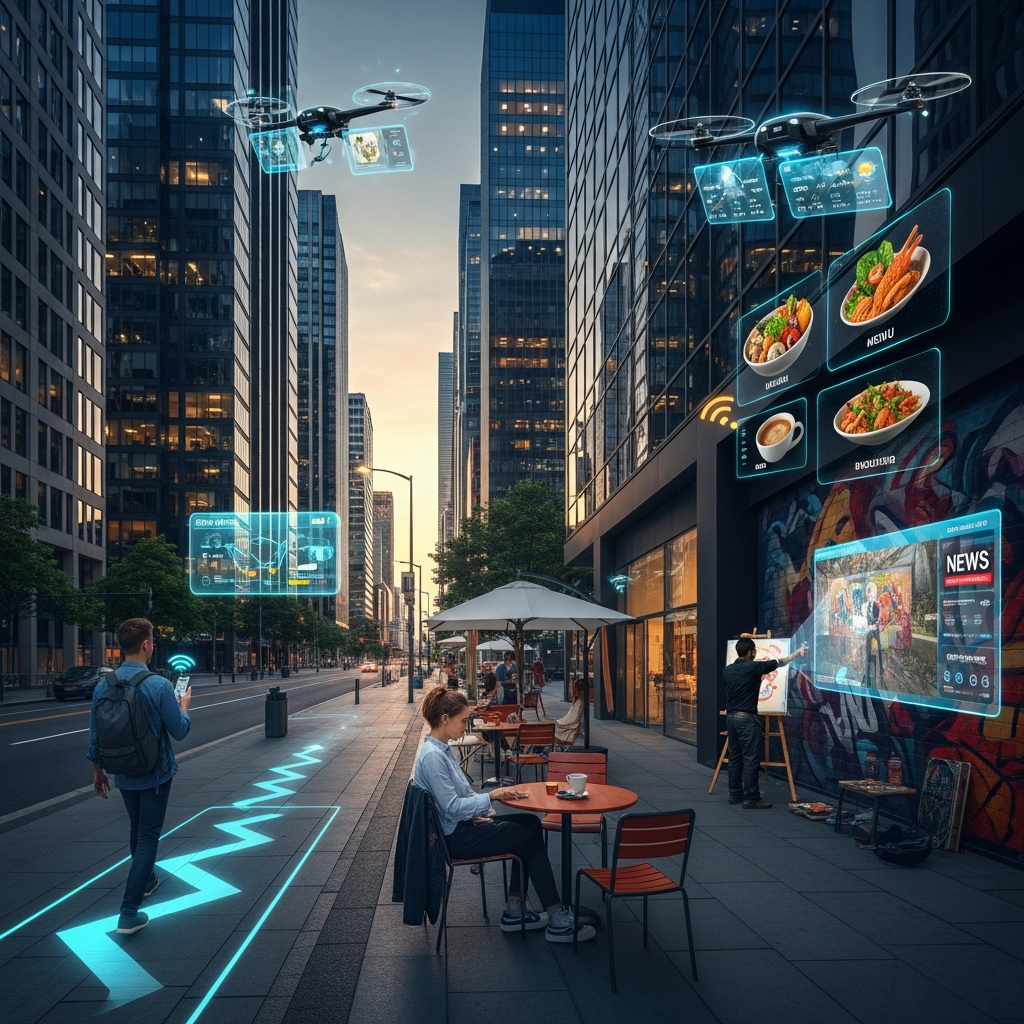
- AR Apps: Reshaping Industries and Daily Life
- Effortless Innovation: Making AR Accessible
- The Road Ahead: Challenges and Future Prospects
AR apps are no longer a futuristic dream confined to science fiction; they are a vibrant, rapidly evolving reality already impacting how we interact with the world. By overlaying digital information onto our real-world view, augmented reality applications promise a future that is not only stunning in its potential but also surprisingly effortless in its emerging innovation. From simple smartphone filters to complex industrial tools, AR is subtly, yet profoundly, reshaping industries and our daily lives, merging the digital and physical realms in increasingly seamless ways.
At its core, Augmented Reality (AR) uses technology to enhance our perception of reality by adding computer-generated elements to a live view, most often through a smartphone camera, tablet, or specialized AR glasses. Unlike Virtual Reality (VR), which fully immerses users in a simulated environment, AR maintains the user’s connection to the real world, simply augmenting it with digital content. This could be anything from a virtual couch placed in your living room to interactive labels appearing over real objects in a factory. The magic happens through sophisticated algorithms that track the device’s position and orientation, interpret the environment, and then render digital objects that appear to “exist” within that space. Advanced spatial mapping, depth sensing, and AI object recognition are constantly making these experiences more realistic and responsive.
AR Apps: Reshaping Industries and Daily Life
The true power of AR apps lies in their versatility, enabling ground-breaking applications across a multitude of sectors:
Retail and E-commerce: Imagine trying on clothes virtually or seeing how a new sofa would look in your living room before making a purchase. Apps from companies like IKEA and Sephora already allow customers to visualize products in their own space, significantly reducing buyer’s remorse and enhancing the online shopping experience.
Education and Training: AR is transforming learning into an immersive adventure. Students can explore 3D models of the human heart, dissect virtual frogs, or journey through ancient civilizations, all within the confines of their classroom or home. For professional training, AR can provide guided instructions for complex machinery or simulate high-stakes scenarios without real-world risk. Medical students, for instance, can practice surgical procedures with realistic overlays on anatomical models.
Manufacturing and Maintenance: In industrial settings, AR apps are invaluable for task guidance, quality assurance, and remote assistance. Technicians wearing AR glasses can receive step-by-step instructions overlaid onto machinery, identify faulty parts, or connect with remote experts who can “see” what they see and provide real-time guidance. This drastically reduces errors, downtime, and the need for costly travel.
Healthcare: From visualizing patient data during surgery to helping nurses locate veins, AR offers tremendous potential. It can also provide interactive patient education, allowing individuals to understand medical conditions and treatments in a more intuitive, visual way.
Gaming and Entertainment: Perhaps the most widely recognized early success of AR was Pokémon GO, which demonstrated to millions the joy of interacting with digital characters in their real-world surroundings. Beyond gaming, AR enhances live events, brings museum exhibits to life, and creates captivating interactive art installations.
Navigation and Tourism: AR overlays directions onto the real world, making it easier to find your way in unfamiliar cities. Tourist apps can provide instant information about landmarks, historical facts, or local recommendations simply by pointing your phone’s camera at a building or monument.
* Design and Architecture: Architects and designers can walk through virtual models of buildings or interior spaces projected onto a real construction site or an empty room, speeding up design iterations and improving client communication.
Effortless Innovation: Making AR Accessible
What makes the innovation around AR apps particularly “effortless” isn’t just the seamless user experience, but also the increasing accessibility of development tools. Major tech companies like Apple (ARKit) and Google (ARCore) have provided robust SDKs (Software Development Kits) that allow developers to create sophisticated AR experiences with relative ease, leveraging the powerful cameras and processors already present in billions of smartphones. This democratization of AR development means that innovative ideas can quickly transition from concept to functional application, without requiring specialized, expensive hardware for end-users. Businesses and individual creators alike can tap into this technology, fostering a constant stream of new and imaginative uses for AR. The widespread adoption of smartphones has effectively turned every mobile device into a potential AR window, making the technology ubiquitous and convenient for users.
The Road Ahead: Challenges and Future Prospects
While the progress is undeniable, AR apps still face challenges. Hardware limitations, such as battery life, processing power, and the relatively small field of view on most smartphone screens, can restrict the depth and length of AR experiences. True full immersion without a device in hand awaits the widespread adoption of lightweight, comfortable AR glasses, a goal that many tech giants are relentlessly pursuing. Privacy concerns, particularly regarding real-time environment scanning and data collection, also need careful consideration as AR becomes more integrated into our lives.
Despite these hurdles, the trajectory of AR app development is clear. As 5G connectivity improves, AI capabilities advance, and dedicated AR hardware evolves, the boundaries between our physical and digital worlds will continue to blur. AR apps stand at the forefront of this transformation, promising a future where information, interaction, and imagination are effortlessly intertwined with our reality. The stunning potential is just beginning to unfold, inviting us all to explore the infinite possibilities of an augmented world.
0 Comments